Differentiable simulators and neural surrogates for optimization and inverse problems.
Many scientific problems already come with a physical model. The trouble is that the model is often too slow, or not differentiable, to sit inside a learning or optimization loop. This theme is about removing that obstacle: make the physics itself differentiable, or replace its expensive parts with neural surrogates, so that gradients flow from end to end. Once they do, hard search and calibration problems turn into gradient descent.
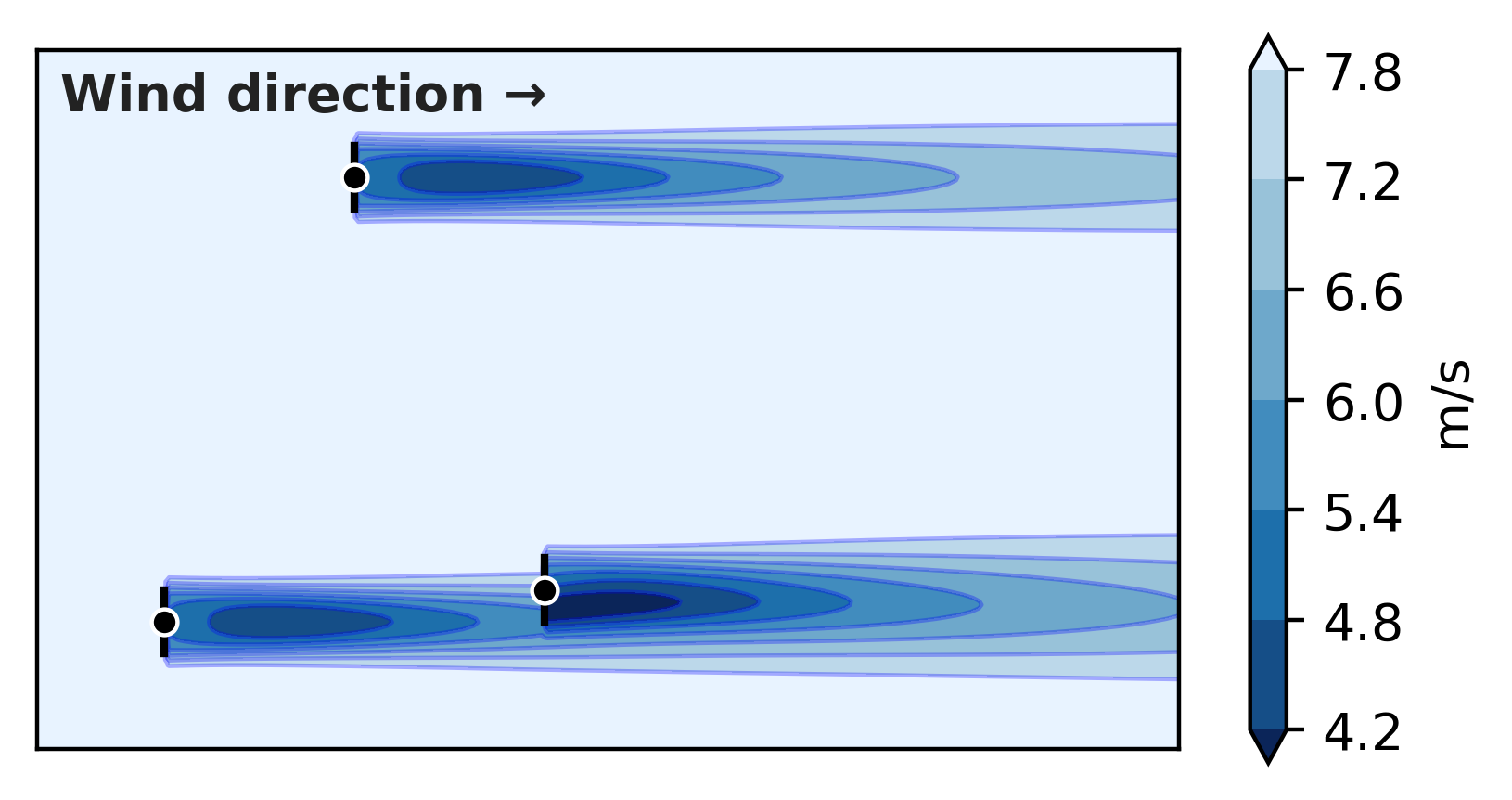
Wind energy is a clear example. Turbine wakes reduce the power of downstream turbines, and engineers model them well, but the standard models were not written to be differentiated. DiffWake rebuilds this machinery in JAX, including the first differentiable cumulative-curl wake model, which makes layout optimization about fifty times faster and lets turbulence parameters be calibrated directly against operational data (Bånkestad et al., 2025).
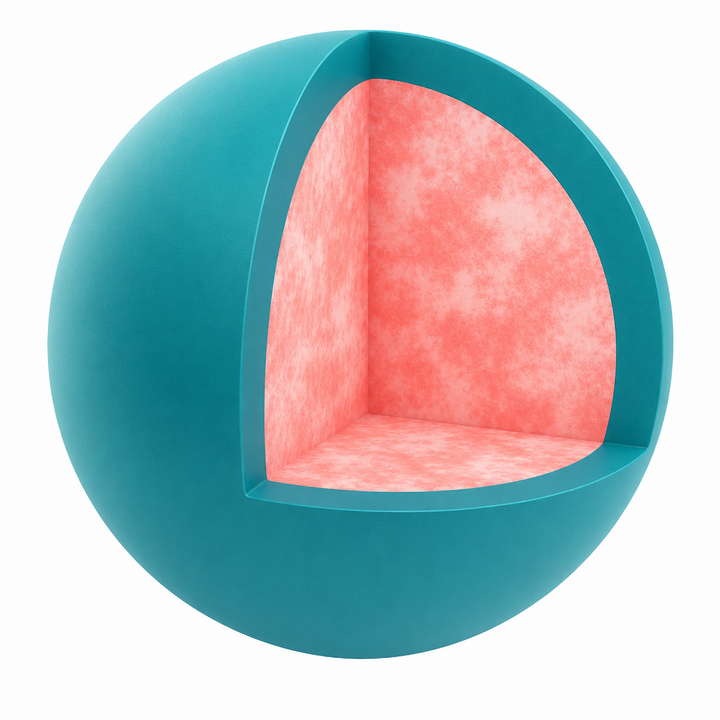
The same approach reads structure out of measurements. In small-angle X-ray scattering, recovering a nanoparticle’s internal structure from its scattering curve is an inverse problem with non-unique solutions and a slow forward model. A neural surrogate plus a differentiable pipeline makes large-scale fitting and honest identifiability analysis possible (Bånkestad et al., 2026). Ongoing work in the CoSiMa project extends this line to soft materials characterized at synchrotron beamlines.
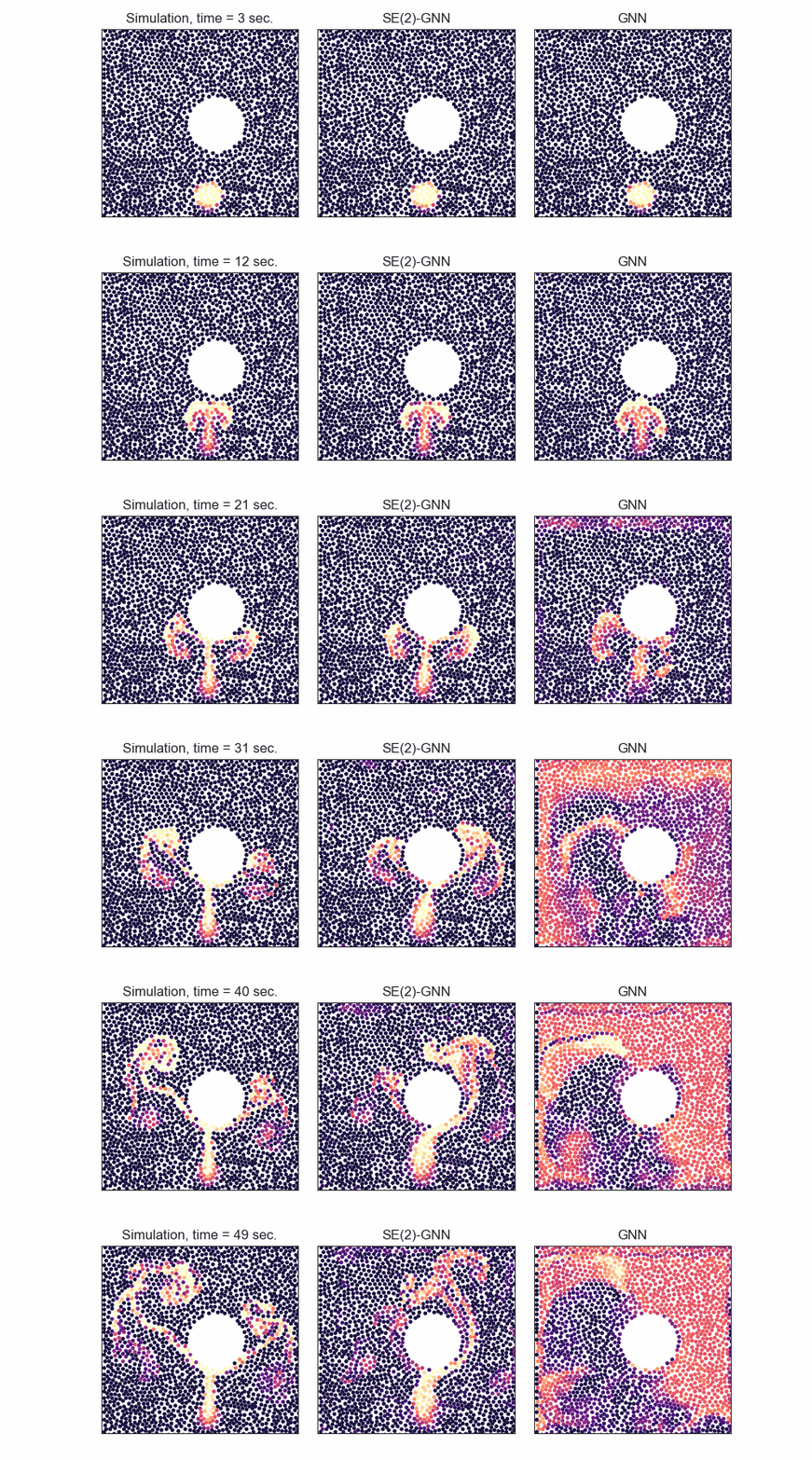
The fluid surrogates developed under the geometry theme belong here too: an equivariant network that stands in for an expensive flow simulation is exactly this kind of fast, learned surrogate (Bånkestad et al., 2024).
Lipid nanoparticles (LNPs) are efficient delivery systems for negatively charged nucleic acids. Their multi-component architecture yields a core-shell structure. Small-angle X-ray scattering (SAXS) is an important characterization technique for LNPs, but recovering internal structure and size distribution from SAXS is an inverse problem with non-unique solutions. Realistic models are often too expensive for systematic exploration. We introduce a machine-learning-accelerated, differentiable framework for SAXS analysis of heterogeneous, polydisperse LNPs. The forward model combines a core-shell particle with a Gaussian random-field interior, a neural surrogate for the monodisperse SAXS map, and a differentiable layer integrating over particle-size distributions. The surrogate reduces prediction cost by four orders of magnitude, while differentiability enables large-scale multi-start fitting and ensemble identifiability analysis. Applied to synthetic and experimental MC3 LNP data, the framework shows that near-identical SAXS fits can arise from distinct parameter modes, with the experimental fits dominated by a trade-off between size-distribution and interior-structure parameters.
@article{bankestad2026saxs,title={A differentiable machine learning small-angle X-ray scattering analysis framework for structure elucidation of lipid nanoparticles},author={B{\aa}nkestad, Maria and Barman, Sandra and R{\"o}ding, Magnus and Kaunisto, Erik and Meklesh, Viktoriia and Gallud, Audrey and Mendez, Marco and Yanez Arteta, Marianna and Norberg, Stefan and Terry, Ann and Chakraborty, Smita and Yu, Shun and R{\"o}nnols, Jerk and Pashami, Sepideh},journal={arXiv preprint arXiv:2606.05200},year={2026},}
2025
EurIPS-W
DiffWake: A General Differentiable Wind Farm Solver in JAX
Maria Bånkestad, Leon Sütfeld, Aleksis Pirinen, and 1 more author
In Workshop on Differentiable Systems and Scientific Machine Learning (EurIPS) , 2025
We present DiffWake, a general differentiable wind farm solver implemented in JAX, including the first differentiable implementation of the cumulative-curl wake model. End-to-end differentiability enables fast gradient-based wind farm layout optimization and probabilistic calibration of turbulence intensity from data. On layout optimization, L-BFGS converges roughly fifty times faster than a FLORIS/SciPy baseline, and the calibration approach improves turbulence-intensity prediction on operational SCADA data.
@inproceedings{bankestad2025diffwake,title={DiffWake: A General Differentiable Wind Farm Solver in JAX},author={B{\aa}nkestad, Maria and S{\"u}tfeld, Leon and Pirinen, Aleksis and Abedi, Hamidreza},booktitle={Workshop on Differentiable Systems and Scientific Machine Learning (EurIPS)},year={2025},}
2024
Flexible SE(2) graph neural networks with applications to PDE surrogates
This paper presents a novel approach for constructing graph neural networks equivariant to 2D rotations and translations and leveraging them as PDE surrogates on non-gridded domains. We show that aligning the representations with the principal axis allows us to sidestep many constraints while preserving SE(2) equivariance. By applying our model as a surrogate for fluid flow simulations and conducting thorough benchmarks against non-equivariant models, we demonstrate significant gains in terms of both data efficiency and accuracy.
@article{bankestad2024flexible,title={Flexible SE(2) graph neural networks with applications to PDE surrogates},author={B{\aa}nkestad, Maria and Mogren, Olof and Pirinen, Aleksis},journal={arXiv preprint arXiv:2405.20287},year={2024},}