Differentiable and learned models for wind energy and fluid flows.
Energy systems and fluid flows are governed by physics we understand well, but simulating that physics accurately is expensive, and the standard solvers were not written to be differentiated. That rules out the two things I most want to do with them: optimize over them, and calibrate them against data. Both of my projects here remove that obstacle, either by making the physics differentiable or by replacing its slow parts with a learned surrogate.
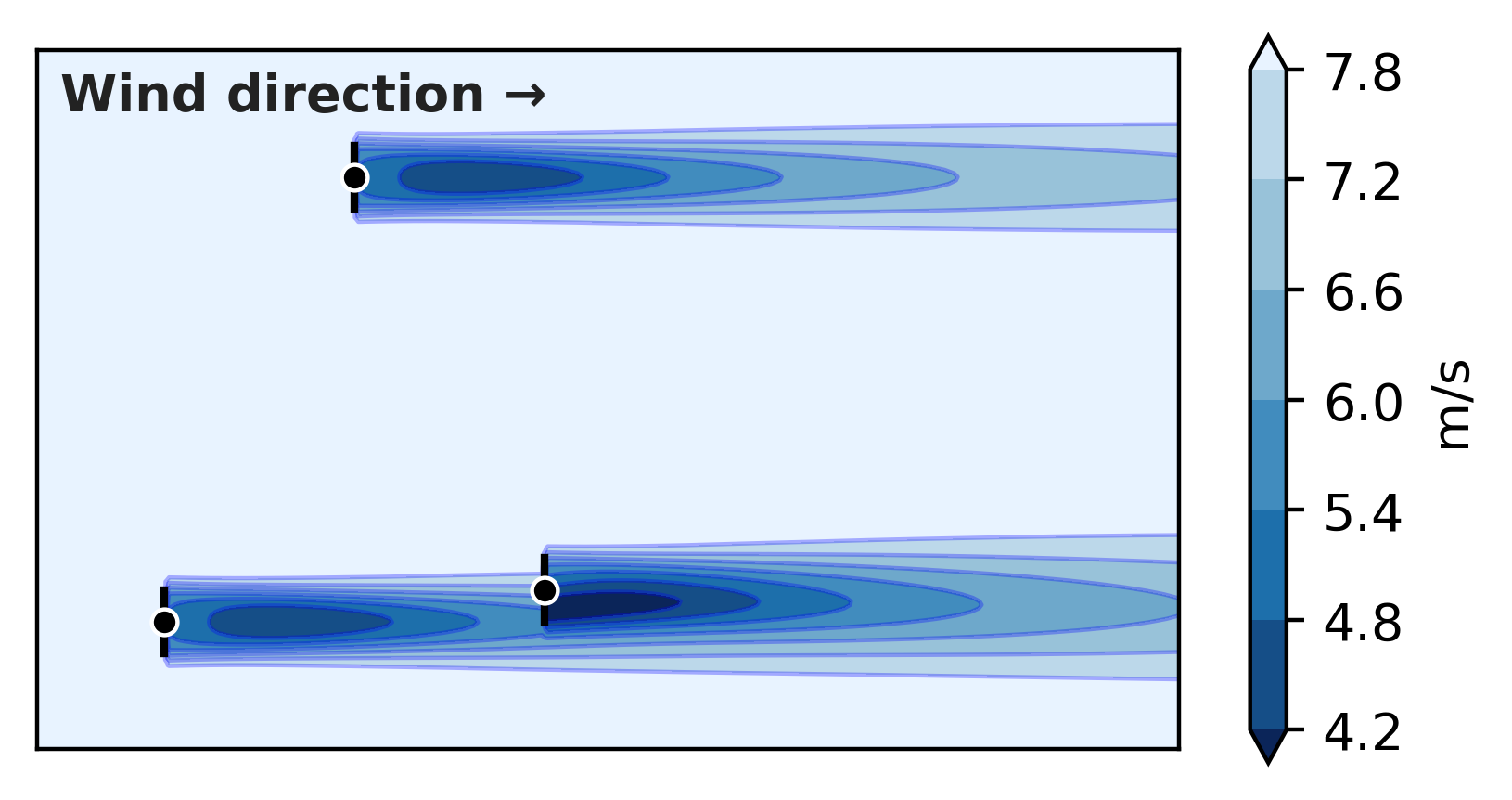
Wind energy is the clearest case. Turbine wakes rob downstream turbines of power, and predicting them well is central to how a wind farm is laid out and run. DiffWake rebuilds this machinery in JAX, including the first differentiable cumulative-curl wake model, which makes layout optimization about fifty times faster and lets turbulence parameters be calibrated directly against operational data (Bånkestad et al., 2025).
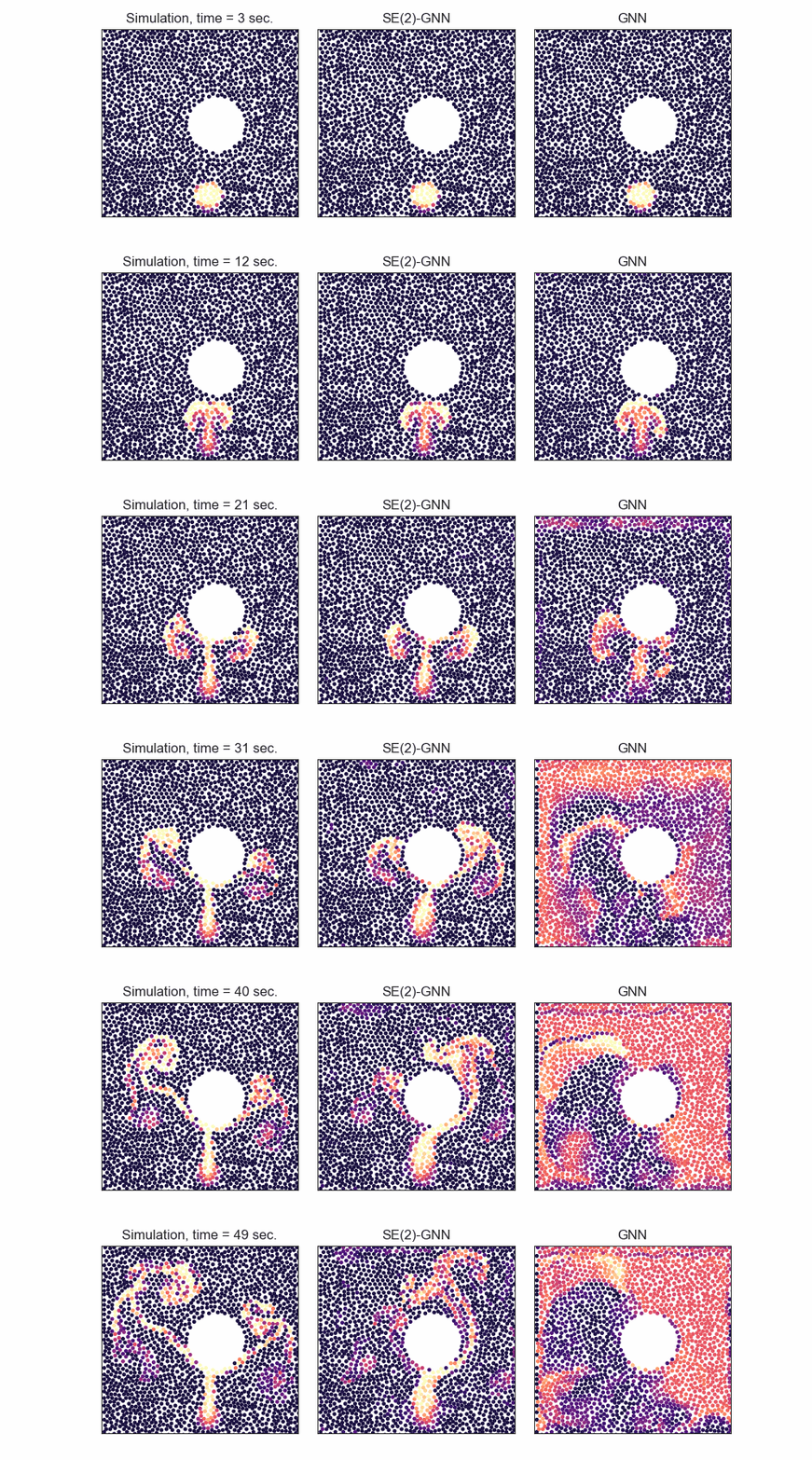
Fluid simulation more broadly is a natural target for learned surrogates. An equivariant graph neural network that respects the rotational and translational symmetry of a flow gives accurate, stable rollouts from limited data, and runs far faster than the simulation it stands in for (Bånkestad et al., 2024).
We present DiffWake, a general differentiable wind farm solver implemented in JAX, including the first differentiable implementation of the cumulative-curl wake model. End-to-end differentiability enables fast gradient-based wind farm layout optimization and probabilistic calibration of turbulence intensity from data. On layout optimization, L-BFGS converges roughly fifty times faster than a FLORIS/SciPy baseline, and the calibration approach improves turbulence-intensity prediction on operational SCADA data.
@inproceedings{bankestad2025diffwake,title={DiffWake: A General Differentiable Wind Farm Solver in JAX},author={B{\aa}nkestad, Maria and S{\"u}tfeld, Leon and Pirinen, Aleksis and Abedi, Hamidreza},booktitle={Workshop on Differentiable Systems and Scientific Machine Learning (EurIPS)},year={2025},}
2024
Flexible SE(2) graph neural networks with applications to PDE surrogates
This paper presents a novel approach for constructing graph neural networks equivariant to 2D rotations and translations and leveraging them as PDE surrogates on non-gridded domains. We show that aligning the representations with the principal axis allows us to sidestep many constraints while preserving SE(2) equivariance. By applying our model as a surrogate for fluid flow simulations and conducting thorough benchmarks against non-equivariant models, we demonstrate significant gains in terms of both data efficiency and accuracy.
@article{bankestad2024flexible,title={Flexible SE(2) graph neural networks with applications to PDE surrogates},author={B{\aa}nkestad, Maria and Mogren, Olof and Pirinen, Aleksis},journal={arXiv preprint arXiv:2405.20287},year={2024},}