Geometry and scattering for proteins and drug-delivery nanoparticles.
Biological structure is three-dimensional, and it is usually hard to observe directly. Whether the object is a protein pocket or the interior of a nanoparticle, the interesting behavior comes from a spatial arrangement we can only measure indirectly. The projects here bring geometry-aware and differentiable methods to that problem, from the same toolkit that runs through the rest of my work.
One thread is protein design. Enzymes that modify cellulose depend on how a protein recognizes and binds a carbohydrate, which is a question about the three-dimensional fit between two structures. This is a natural place for equivariant models, and because experimental validation is expensive, the design loop is framed as active learning. This is ongoing, funded work.
The other thread is reading structure out of measurements. Small-angle X-ray scattering probes the internal structure of lipid nanoparticles, the delivery systems behind nucleic-acid drugs, but recovering that structure from a scattering curve is an inverse problem with non-unique solutions. A differentiable, machine-learning-accelerated framework makes the fitting tractable and its uncertainty honest (Bånkestad et al., 2026).
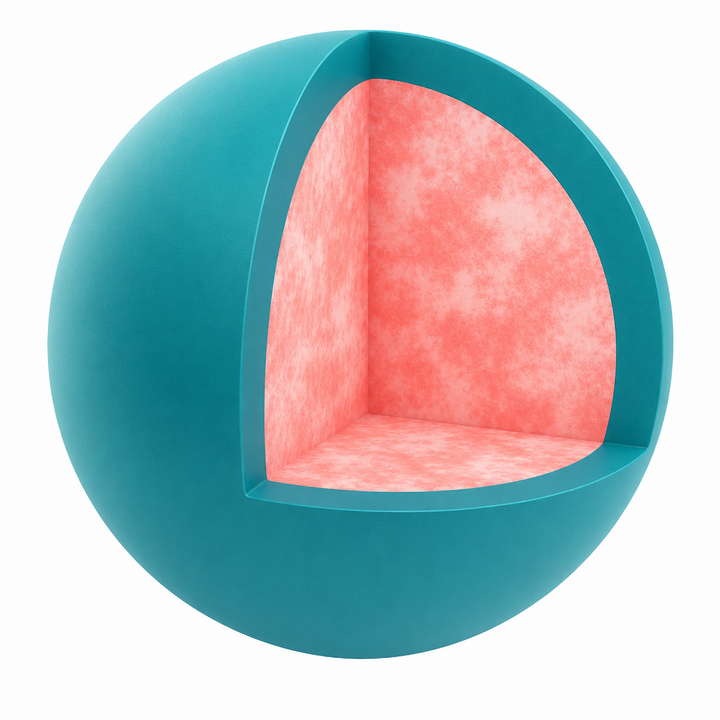
Lipid nanoparticles (LNPs) are efficient delivery systems for negatively charged nucleic acids. Their multi-component architecture yields a core-shell structure. Small-angle X-ray scattering (SAXS) is an important characterization technique for LNPs, but recovering internal structure and size distribution from SAXS is an inverse problem with non-unique solutions. Realistic models are often too expensive for systematic exploration. We introduce a machine-learning-accelerated, differentiable framework for SAXS analysis of heterogeneous, polydisperse LNPs. The forward model combines a core-shell particle with a Gaussian random-field interior, a neural surrogate for the monodisperse SAXS map, and a differentiable layer integrating over particle-size distributions. The surrogate reduces prediction cost by four orders of magnitude, while differentiability enables large-scale multi-start fitting and ensemble identifiability analysis. Applied to synthetic and experimental MC3 LNP data, the framework shows that near-identical SAXS fits can arise from distinct parameter modes, with the experimental fits dominated by a trade-off between size-distribution and interior-structure parameters.
@article{bankestad2026saxs,title={A differentiable machine learning small-angle X-ray scattering analysis framework for structure elucidation of lipid nanoparticles},author={B{\aa}nkestad, Maria and Barman, Sandra and R{\"o}ding, Magnus and Kaunisto, Erik and Meklesh, Viktoriia and Gallud, Audrey and Mendez, Marco and Yanez Arteta, Marianna and Norberg, Stefan and Terry, Ann and Chakraborty, Smita and Yu, Shun and R{\"o}nnols, Jerk and Pashami, Sepideh},journal={arXiv preprint arXiv:2606.05200},year={2026},}