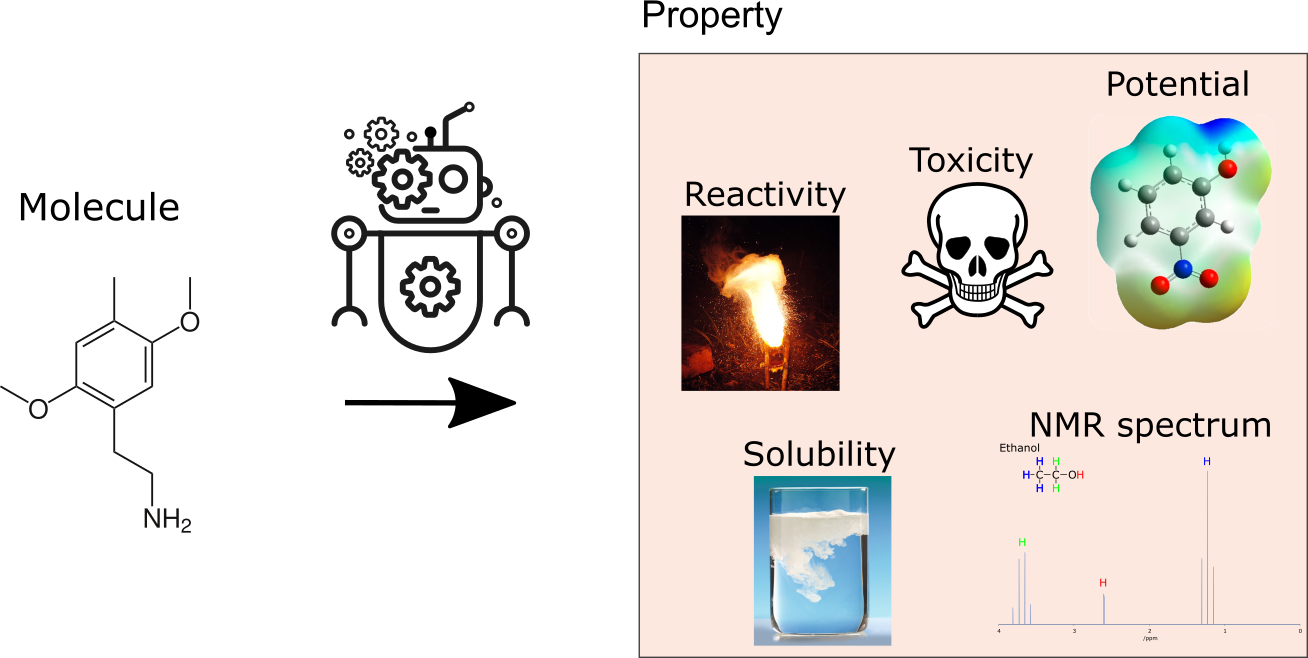
Machine learning for molecules, materials, and the measurements that probe them.
A large part of my work is aimed at chemistry and materials. The methods come from the other themes on this page, equivariant models, probabilistic methods, and differentiable physics, but here they are gathered around the science they serve: predicting properties, guiding experiments, designing proteins, and reading structure out of measurements. The projects below also appear under their method themes; this page collects them from the application side.
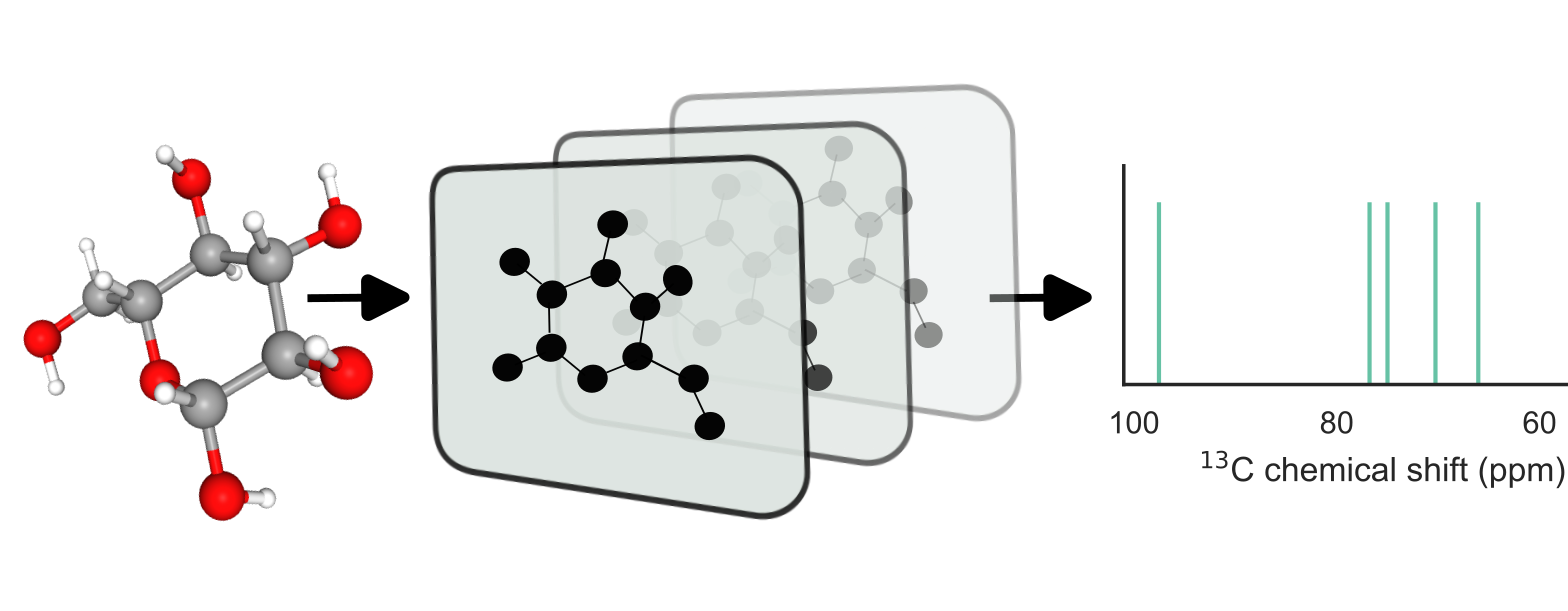
Two threads concern prediction from structure. For carbohydrates, an equivariant model predicts NMR chemical shifts far more accurately than structure-blind baselines (Bånkestad et al., 2024), and ongoing work carries the same idea to NMR in crystalline solids. Both aim at the same practical goal: getting a property or a spectrum without a slow measurement or calculation.
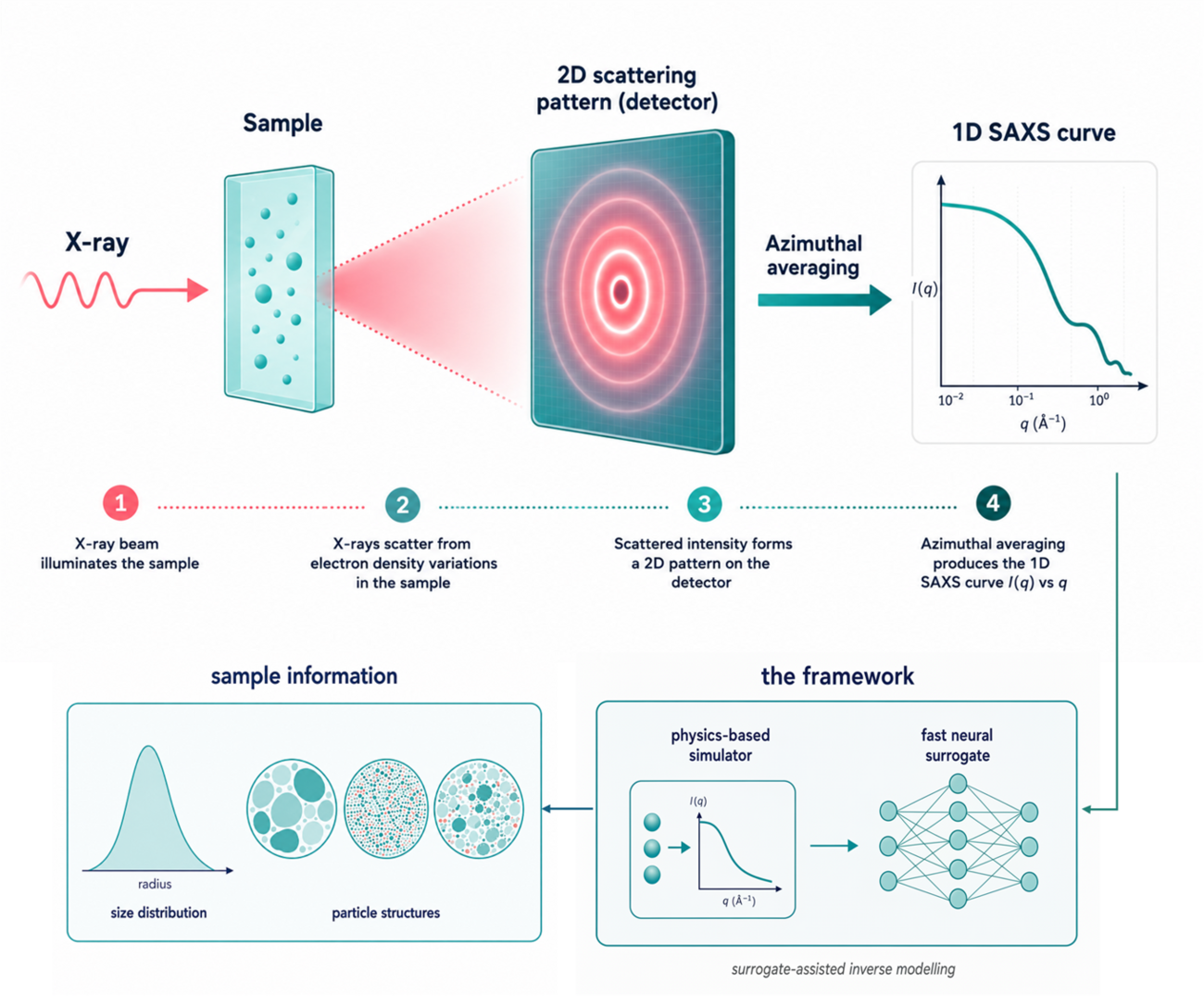
A second thread is about measurements themselves. Small-angle X-ray scattering probes the internal structure of nanoparticles, and a differentiable, ML-accelerated framework makes that structure recoverable and its uncertainty honest (Bånkestad et al., 2026). The ongoing CoSiMa project extends this to soft materials studied at large-scale facilities.
The rest of the work is about deciding what to make and measure next. An active-learning project chooses which solubility experiments to run, and a funded collaboration designs proteins that modify cellulose, using geometry and active learning together.
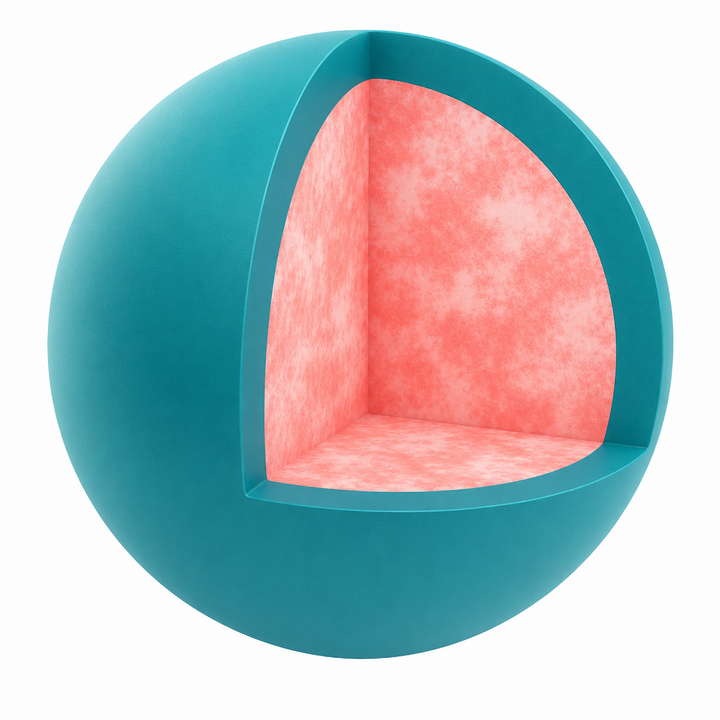
Lipid nanoparticles (LNPs) are efficient delivery systems for negatively charged nucleic acids. Their multi-component architecture yields a core-shell structure. Small-angle X-ray scattering (SAXS) is an important characterization technique for LNPs, but recovering internal structure and size distribution from SAXS is an inverse problem with non-unique solutions. Realistic models are often too expensive for systematic exploration. We introduce a machine-learning-accelerated, differentiable framework for SAXS analysis of heterogeneous, polydisperse LNPs. The forward model combines a core-shell particle with a Gaussian random-field interior, a neural surrogate for the monodisperse SAXS map, and a differentiable layer integrating over particle-size distributions. The surrogate reduces prediction cost by four orders of magnitude, while differentiability enables large-scale multi-start fitting and ensemble identifiability analysis. Applied to synthetic and experimental MC3 LNP data, the framework shows that near-identical SAXS fits can arise from distinct parameter modes, with the experimental fits dominated by a trade-off between size-distribution and interior-structure parameters.
@article{bankestad2026saxs,title={A differentiable machine learning small-angle X-ray scattering analysis framework for structure elucidation of lipid nanoparticles},author={B{\aa}nkestad, Maria and Barman, Sandra and R{\"o}ding, Magnus and Kaunisto, Erik and Meklesh, Viktoriia and Gallud, Audrey and Mendez, Marco and Yanez Arteta, Marianna and Norberg, Stefan and Terry, Ann and Chakraborty, Smita and Yu, Shun and R{\"o}nnols, Jerk and Pashami, Sepideh},journal={arXiv preprint arXiv:2606.05200},year={2026},}
2024
RSC Adv.
Carbohydrate NMR chemical shift prediction by GeqShift employing E(3) equivariant graph neural networks
Maria Bånkestad, Keven M. Dorst, Göran Widmalm, and 1 more author
Carbohydrates, vital components of biological systems, are well-known for their structural diversity. Nuclear Magnetic Resonance (NMR) spectroscopy plays a crucial role in understanding their intricate molecular arrangements and is essential in assessing and verifying the molecular structure of organic molecules. An important part of this process is to predict the NMR chemical shift from the molecular structure. This work introduces a novel approach that leverages E(3) equivariant graph neural networks to predict carbohydrate NMR spectra. Notably, our model achieves a substantial reduction in mean absolute error, up to threefold, compared to traditional models that rely solely on two-dimensional molecular structure. Even with limited data, the model excels, highlighting its robustness and generalization capabilities.
@article{bankestad2024carbohydrate,title={Carbohydrate NMR chemical shift prediction by GeqShift employing E(3) equivariant graph neural networks},author={B{\aa}nkestad, Maria and Dorst, Keven M. and Widmalm, G{\"o}ran and R{\"o}nnols, Jerk},journal={RSC Advances},volume={14},pages={26585--26595},year={2024},doi={10.1039/D4RA03428G},}